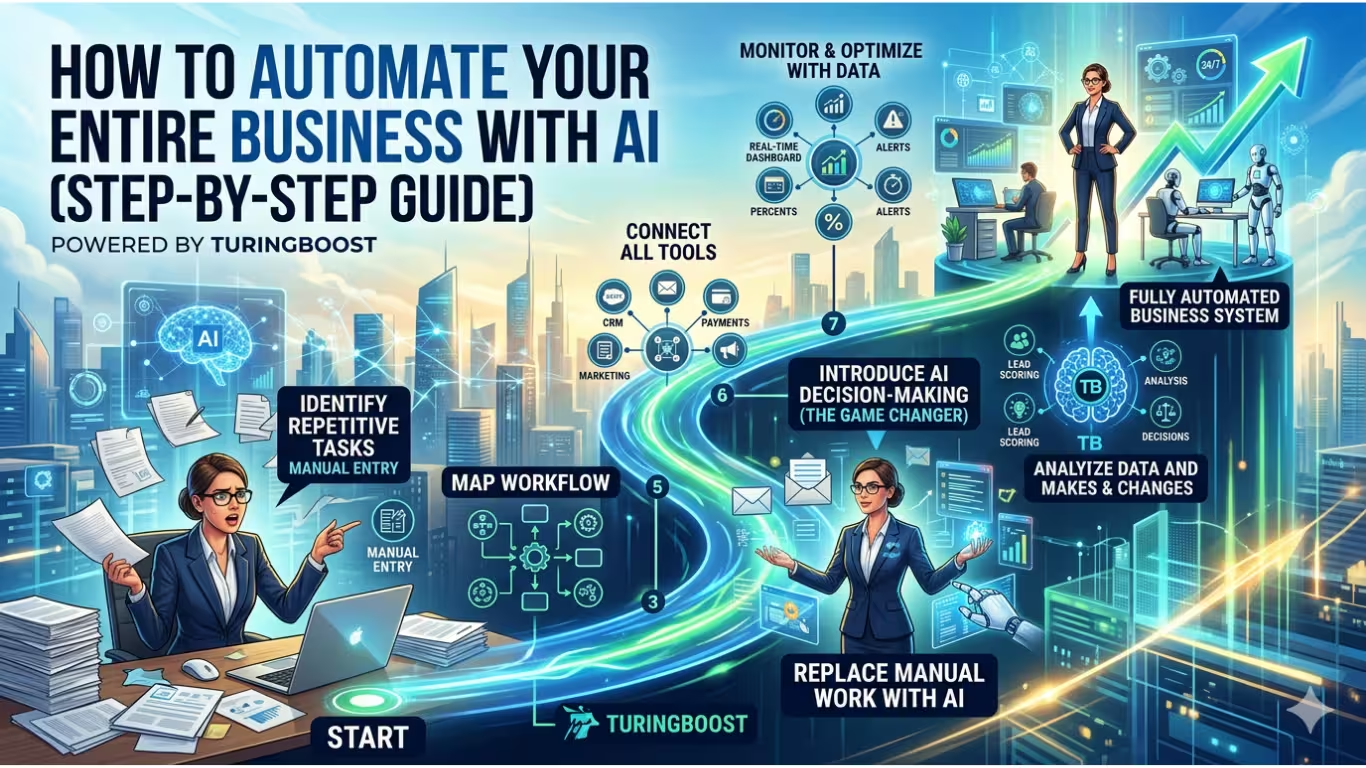



Automated business drivers are reshaping how companies scale. While most businesses collect tools, leading companies build intelligent systems that execute tasks, analyze performance, and optimize outcomes automatically.
If your automation does not improve itself while you sleep, you do not have automated business drivers – you have digital busywork.
Why Most Businesses Fail to Scale (Even With Automation Tools)
The average mid-size company uses 137 different SaaS tools. Yet 68% of their data never leaves the silo it entered. They have automated tasks, but not outcomes.
Here is what that looks like in practice:
A marketing agency we audited spent 23 hours per week manually compiling client reports from six different platforms. Their “automation” was copy-paste. Their “dashboard” was a maze of browser tabs. When a campaign started underperforming, they discovered it in next week’s review meeting—if they discovered it at all.
This is not rare. It is the norm.
Too many disconnected tools. Data that exists but generates no actionable insights. Manual decision-making that slows every growth initiative. Teams stuck in repetitive workflows that feel productive but do not compound.
The hard truth: Automation without intelligence is just faster chaos. You need automated business drivers—systems that do not just run, they improve.
What Are Automated Business Drivers?
Automated business drivers are AI-powered systems that execute tasks, analyze performance, and continuously optimize outcomes—turning operational data into revenue decisions without human bottlenecks.
This is the critical shift most businesses miss.Table
| Basic Automation | Automated Business Drivers |
|---|---|
| Does tasks | Improves outcomes |
| Connects apps | Connects insights |
| Saves hours | Scales revenue |
| Static workflows | Self-optimizing systems |
Basic automation asks: “Can we do this faster?”
Automated business drivers ask: “Can this improve itself while we sleep?”
The 3 Core Layers of Automated Business Drivers
Layer 1: Workflow Automation
Eliminates repetitive tasks at scale. Not just “send this email automatically”—but “execute entire operational sequences based on real-time triggers.”
Layer 2: Data Intelligence
Real-time dashboards that do not just display metrics but surface anomalies, trends, and opportunities across departments.
Layer 3: Decision and Optimization (The Game-Changer)
AI detects patterns humans miss, suggests improvements, and autonomously adjusts execution.
Example: Your automated business driver notices Tuesday email campaigns convert 34% better. It automatically shifts send schedules, reallocates budget toward high-performing segments, and flags the pattern to your team—before you have finished your morning coffee.
This is not future tech. This is what separates businesses that scale from those that stall.
How AI-Powered Automated Business Drivers Actually Drive Growth
Marketing Agencies
- Automated reporting dashboards — Reduce client reporting from 8 hours to 15 minutes
- Real-time campaign performance insights — Catch underperforming spend within 2 hours, not 2 weeks
Result: Account managers focus on strategy, not spreadsheet wrestling. Client retention improves because problems get solved before clients notice them.
E-commerce Businesses
- Sales trend monitoring — Identify inventory gaps 7 days before stockouts
- Customer behavior analysis — Spot churn signals 30 days early
- Automated operational decisions — Dynamic pricing, inventory reorders, and promotional triggers
Result: Revenue protection becomes proactive, not reactive. You stop losing sales to stockouts and customers to competitors who responded faster.
Tech Companies
- Product analytics automation — Track feature adoption in real-time, not monthly
- Internal workflow optimization — Engineering handoffs, QA processes, deployment pipelines that self-improve
Result: Product velocity increases without headcount inflation. Decisions happen at the speed of data, not the speed of scheduled meetings.
Enterprise Teams
- Centralized data systems — Unify 12+ data sources into one decision dashboard
- Cross-department automation — Marketing, sales, and operations synchronized by intelligent triggers
Result: Break down silos that have existed for years. Decisions that required three meetings and five email chains now happen automatically.
5 Ways Automated Business Drivers Increase Revenue
Table
| Revenue Driver | Concrete Impact |
|---|---|
| 24/7 Operational Efficiency | Processes that used to pause at 6 PM now run continuously. Global operations do not wait for timezone handoffs. |
| Faster, Data-Driven Decisions | Reduce decision lag from weeks to hours. In competitive markets, speed is revenue. |
| Reduced Human Error | Eliminate 90% of manual reporting mistakes. One data error in a $50K campaign decision pays for an entire automated business driver system. |
| Scalable Systems Without Linear Hiring | Handle 3x volume with the same team size. Your best people focus on growth, not maintenance. |
| Unified View of True Performance | See actual customer LTV across all touchpoints. Stop optimizing for vanity metrics that do not deposit in your bank account. |
The AI Objection: Why Intelligence Amplifies (Not Replaces) Human Decisions
Let us address the fear directly.
AI does not make your strategic decisions. It removes the 20 hours of data-gathering and spreadsheet-wrestling so you can make those decisions in 20 minutes—with complete information, not partial snapshots.
The marketing director still decides the campaign strategy. But now she knows exactly which segments are converting, which creative is fatiguing, and where to reallocate budget before the weekly review meeting.
The operations manager still sets inventory policies. But now he is alerted to demand shifts days before they become stockouts or overstock situations.
Human judgment plus machine speed equals competitive advantage.
The Hidden Advantage: From Automation to Intelligence
Most articles tell you to “automate your emails” or “use a CRM.”
Here is what they miss:
plain
Copy
TOOLS → WORKFLOWS → INSIGHTS → OPTIMIZATION → AUTONOMOUS GROWTH
(Zapier)  (Basic)    (BI)       (AI Suggestions)  (Self-improving)
Most businesses stop at “Workflows.” They connect apps, save some time, and wonder why growth still feels hard.
Automated business drivers operate at the Optimization and Autonomous Growth layers. They do not just execute. They evaluate. They evolve. They compound advantages while you sleep.
This is the difference between having automation and being driven by automation.
How to Build Automated Business Drivers: The 8-Week Framework
Weeks 1-4: Foundation
Step 1: Map Your Workflows
Identify repetitive operations that consume 10+ hours weekly. Document decision points where humans wait for data.
Step 2: Centralize Your Data
Break silos. If your marketing data lives in three platforms and never meets, you cannot optimize what you cannot see.
Warning: Skip this step and you will automate garbage workflows faster.
Step 3: Automate Execution
Remove manual processes for data collection, reporting, and routine operational tasks.
Weeks 5-6: Visibility
Step 4: Add Analytics and Dashboards
Track everything in real-time. But more importantly: set up anomaly detection. You want alerts when metrics deviate, not just when they hit thresholds.
Weeks 7-8: Intelligence
Step 5: Layer AI Insights
Turn data into decisions. Start with suggestions, then progress to autonomous optimization for low-risk, high-volume decisions.
Timeline Reality Check: Most businesses get stuck at Step 3. They automate tasks but never build the intelligence layer that makes those tasks self-improving. That is why they plateau.
Download our 8-week implementation checklist for automated business drivers.
Why Most Automation Strategies Fail
Table
| Failure Mode | Symptom | The Fix |
|---|---|---|
| Tool Overload | 15+ apps, no integration, subscription fatigue | Consolidate to 3-4 core systems with open APIs |
| Data Silos | “I have reports, not insights” | Centralize data architecture before automating workflows |
| No Optimization Layer | “It runs, but does not improve” | Add AI analytics that suggest and eventually automate decisions |
| Wrong Metrics | “We track vanity metrics that do not correlate with revenue” | Tie every automated business driver to a revenue or cost KPI |
Without intelligence, automation becomes chaos. You move faster in the wrong direction.
The Future of Automated Business Drivers
We are approaching an inflection point.
By 2027, “automation” will mean autonomous optimization. The businesses still manually reviewing weekly dashboards will be competing against automated business drivers that self-correct in real-time.
- AI-driven operations will be baseline, not differentiator
- Predictive analytics will shift from “nice to have” to “required to compete”
- Real-time decision engines will replace scheduled review meetings
The question is not whether you will adopt automated business drivers. It is whether you will be early enough to capture the compounding advantages—or late enough to play catch-up against competitors who did.
Conclusion: The Shift From Tools to Systems
Businesses that rely on tools stay busy.
Businesses that build automated business drivers scale.
The gap is not in the technology available. It is in the architecture of how that technology is applied. Tools execute. Systems improve. Drivers scale.
Your competitors are not just buying software. They are building automated business drivers that compound advantages daily. The gap between “busy with automation” and “scaling with intelligence” widens every quarter.
The only question is which side of that gap you will be on.
Ready to Build Your Automated Business Drivers?
Get Your Free Automation Audit
See exactly which 3 workflows are costing you revenue—and how to turn them into self-optimizing automated business drivers that scale.
[Request Your Free Audit]
In 30 minutes, we will map your current automation gaps and show you the specific intelligence layer that would drive measurable revenue growth in your business.